Michael C. Kennedy's Weblog - 11 Killer Open Source Projects I Found with NuGet: "11 Killer Open Source Projects I Found with NuGet
Wednesday, January 19, 2011 5:18:17 PM (Pacific Standard Time, UTC-08:00)
So maybe I'm late to the party, but I recently started playing with NuGet. It's a killer new way to find, install, maintain, and manage references to open source libraries in Visual Studio 2010. Plenty of people have written about it (Phil Haack and Scott Hanselman for example). Let's just say you should learn about NuGet if you don't know it already.
What I want to talk about is all the cool open source projects I found just by flipping through the pages of the NuGet directory in the Visual Studio 'Add Library Package Reference' dialog."
Friday, January 21, 2011


Monday, December 27, 2010
Kill That Util Class!
According to him, a static "Helper" or "Util" class is an anti-pattern in a language like C#, which has extension methods, so kill it!
Interesting take. I'd agree that it can greatly reduce the incidence of such classes, yes.
Saturday, December 11, 2010
The protocol-relative URL
From Paul Irish: The protocol-relative URL: "There's this little trick you can get away with that'll save you some headaches:
<img src="//domain.com/img/logo.png">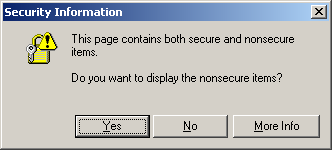 If the browser is viewing that current page in through HTTPS, then it'll request that asset with the HTTPS protocol, otherwise it'll typically* request it with HTTP. This prevents that awful "This Page Contains Both Secure and Non-Secure Items" error message in IE, keeping all your asset requests within the same protocol."
Thursday, December 09, 2010
Algorithmia Source Code released on CodePlex - Frans Bouma's blog
This code library is used by the LLBLGen Pro 3.0 designer, so it's stable and tested.
The undo/redo looks intriguing.
The undo/redo looks intriguing.
Saturday, December 04, 2010
CODE Magazine - Article: Behavior-Driven Development
Uniting XP, Scrum, and BDD.
Wednesday, November 24, 2010
Naïve Bayesian Classification Using C# and ASP.NET
Gonna learn me some Bayesian inference. Maybe.
To understand and code for the na ve Bayesian algorithm, we will do some math to understand the procedure. The primary equation for the Bayes rule is:
P(A|B) = (P(B|A) * P(A)) / P(B)"
There's also this: http://nbayes.codeplex.com/
and this: Inference in Belief Networks - CodeProject
InfoQ: Testing Techniques for Applications With Zero Tests
InfoQ: Testing Techniques for Applications With Zero Tests: "Agile techniques recommend having adequate unit and acceptance tests to build a robust test harness around the application. However, in the real world, not all applications are fortunate enough to have a test harness. In an interesting discussion on the Agile Testing group, members suggested ways to test applications which do not have any automated tests."
A six-step approach is outlined.
InfoQ: How To Do Large Scale Refactoring
InfoQ: How To Do Large Scale Refactoring: "Refactoring by definition means changing the internal structure of a program without modifying its external functional behavior. This is mostly done to improve the non-functional attributes of the program thus leading to improved code readability and maintainability. However, refactoring on a large scale often gives jitters to even seasoned Agilists. The Agile community discussed some ways of handling the large scale refactoring."
Strangling was mentioned as a good approach.
This article also discusses the Mikado Method, which is kind of interesting.
Tuesday, November 23, 2010
InfoQ: Fulfilling the Promise of MVC
Supposedly the original intent of MVC, which has since been bastardized. Check out his PhD dissertation, linked to in the article.
Monday, November 22, 2010
So You Want to Interview for a Senior Developer Position…. « If & Else
So You Want to Interview for a Senior Developer Position…. « If & Else - "When my last company imploded in an epic fiery crash, I quickly found myself moving from Nashville, TN to Chattanooga, TN to become part of a growing team that was recruiting for several senior positions. While I’m the most recent full-time senior member to come aboard, we are still actively seeking senior level talent. Since August, I have sat through countless phone screens, phone interviews and a handful of in-person interviews as part of that search. To say that it has been eye-opening and disappointing would be an understatement. The opinions and observations I’m about to share are my own – and do not reflect the views of my employer (an employer who has been gracious and generous not only to me, but to many candidates, including the ones they’ve flown in from across the country, covering the cost of travel). I don’t intend for this post to be an exhaustive treatment of “what to ask senior architect or developer candidates in an interview” – consider it more a discussion of “the minimum requirements for someone (including you) interviewing for a senior developer or architect position”. I genuinely do not mean to come across as the ‘grumpy, impossible to please’ developer/architect. My frustration will be evident, though, so at least that’s out in the open…."
Saturday, November 20, 2010
10 Steps To Become Better .NET Developer - Blog - CQRS and Cloud Computing
10 Steps To Become Better .NET Developer - Blog - CQRS and Cloud Computing: "Here's a list of things you might want to learn about in order to become a better .NET developer. Better developers are eligible to higher paychecks, exciting projects and more freedom in their lifestyles."
Friday, November 12, 2010
Thursday, November 11, 2010
Jurassic - A Javascript Compiler for .NET
Might this come in handy some day?
Jurassic is an implementation of the ECMAScript language and runtime. It aims to provide the best performing and most standards-compliant implementation of JavaScript for .NET. Jurassic is not intended for end-users; instead it is intended to be integrated into .NET programs. If you are the author of a .NET program, you can use Jurassic to compile and execute JavaScript code.
Features
- Supports all ECMAScript 3 and ECMAScript 5 functionality
- Simple yet powerful API
- Compiles JavaScript into .NET bytecode (CIL); not an interpreter
- Deployed as a single .NET assembly (no native code)
- Basic support for integrated debugging within Visual Studio
- Uses light-weight code generation, so generated code is fully garbage collected"
Wednesday, November 10, 2010
Building iPhone Apps with HTML, CSS, and JavaScript
I'm a cheap bastard without a Mac, so ...
Monday, November 08, 2010
Scrum Alliance - New to User Stories?Written for the Scrum Alliance. A CSP’s perspective on user stories, requirements, and use cases
Good definitions -- comparing and contrasting -- between requirements, use cases, and user stories:
Sunday, November 07, 2010
Ultimate Guide to Website Wireframing
Lots of website wire framing tools listed.
Ultimate Guide to Website Wireframing
Saturday, November 06, 2010
Git Source Control Provider
I'll have to try this out too.
Git Source Control Provider: "Visual Studio users are used to see files' source control status right inside the solution explorer, whether it is SourceSafe, Team Foundation Server, Subversion or even Mercurial. This plug-in integrates Git with Visual Studio solution explorer."
FsCheck: A random testing framework
I'll have to check this out.
FsCheck: A random testing framework: "FsCheck is a tool for testing .NET programs automatically. The programmer provides a specification of the program, in the form of properties which functions, methods or objects should satisfy, and FsCheck then tests that the properties hold in a large number of randomly generated cases. While writing the properties, you are actually writing a testable specification of your program. Specifications are expressed in F#, C# or VB, using combinators defined in the FsCheck library. FsCheck provides combinators to define properties, observe the distribution of test data, and define test data generators. When a property fails, FsCheck automatically displays a minimal counter example."